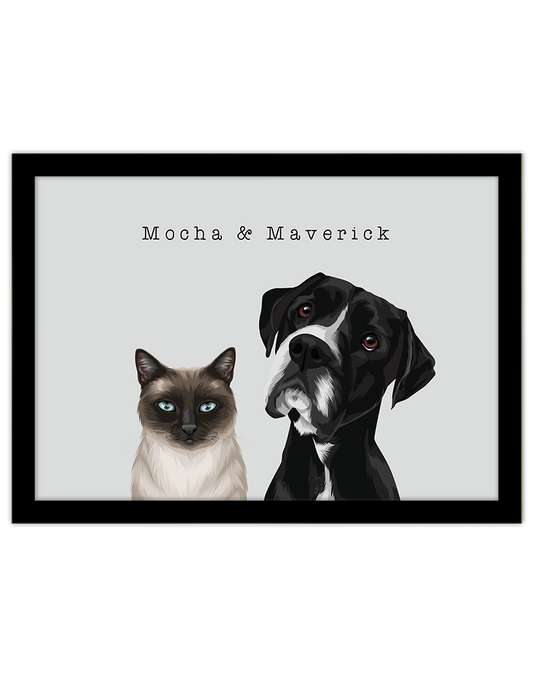

The best photo for a dog portrait shows a clear face, visible eyes and natural markings. Ideally it's taken at dog eye-level, in natural light, with the dog still. The most common mistakes are backlighting, motion blur and cropping the face too tightly.
Why the photo matters more than you'd think
The artist can only work with what's in the image. Backgrounds can be simplified, minor distractions can be cleaned up, but they can't reconstruct a face that's in shadow or guess at markings hidden by blur. A great photo doesn't guarantee a great portrait, but a bad photo makes a great portrait almost impossible.
7 photos that work well
1. Natural light
Overcast days outside or a spot near a window with indirect light are the best options. Avoid direct sun cutting across the face because it creates harsh shadows that hide features. Shade outside works well too.
2. Eye-level angle
Crouch down to the dog's level before you shoot. Photos taken from above make dogs look smaller and less themselves. Eye-level shots have a completely different energy. They look like the dog.
3. Eyes clearly visible
This is the non-negotiable one. The eyes are where character lives in any portrait. If the eyes are obscured by fur, shadow or angle, everything else falls apart.
4. Face fills at least 40% of the frame
You don't need a tight headshot, but you do need enough resolution in the face for the artist to work with. Full-body shots taken from 10 metres away don't give you that.
5. Natural markings visible
The coat pattern, a distinctive patch, the white blaze on the chest: whatever makes your dog recognisably yours needs to be clear. This is what the artist uses to make it look like your dog and not any dog.
6. Dog relaxed and still
Post-walk is the magic window. The 5–15 minutes after a good walk when they've settled but haven't fully checked out yet. Post-meal works too. Mid-zoomies does not. If staying still is the challenge, follow our guide to photographing a dog who won’t sit still.
7. Simple background
Busy backgrounds (cluttered rooms, other people, lots of competing objects) distract from the subject. The simpler the background, the easier it is for the artist to work with the photo.
Once you've found the right image, it can be used to create a custom dog portrait from your photo.
5 photos that cause problems
1. Heavy backlighting
When the light source is behind the dog, the face goes dark. The dog becomes a silhouette with a bright halo. Artists can't recover detail that isn't there.

2. Motion blur
The classic action shot ears mid-flap, mouth mid-bark. It's a great photo of your dog's personality and a terrible photo for a portrait.

3. Heavy shadow over the face
Different from backlighting but just as problematic. Shade that falls directly across the face hides the exact features the artist needs.
4. Extreme wide-angle or fish-eye distortion
Some phones shoot with wide-angle lenses that distort the face significantly, especially noses. The finished portrait ends up looking like the photo, not like the dog.
5. Photo too small or low resolution
A tiny thumbnail of a photo that was always taken at low resolution can't be enlarged without losing all detail. If you're not sure whether your image is large enough, the sending process at Oh Barney will usually flag it.
Special cases worth knowing
Black dogs need directional light to show depth in the coat. A flat, even exposure often turns the coat into a dark mass with no detail. Photographing near a window with light coming from one side helps.
White dogs face the opposite problem: overexposure washes out the coat. A slightly underexposed photo often works better than one where the white has blown out completely.
Curly or long-coated breeds need to show the eyes clearly through the fur. If the coat is obscuring the face, a groomed photo is better than an ungroomed one.
Have an imperfect photograph? Read our guide to using a blurry or older dog photo for a portrait.
Multiple dogs: Oh Barney's artists can combine two or more dogs from separate photos into one portrait. Learn how Oh Barney can combine multiple dogs from separate photographs.
The 60-second portrait-readiness test
Before you order, run your photo through this checklist:
· Lighting clear: no harsh shadows across the face
· Dog's face is in focus (not just sharp in the background)
· Eyes are visible
· Angle is roughly eye-level
· Coat markings and colour are clear
If you get 5 out of 5, you're in good shape. Four out of five is probably fine. Three or fewer: keep shooting or send the image to Oh Barney before ordering and ask whether it'll work.
Portrait-Ready Dog Photo Checklist (save or print this)
1. Lighting: natural, no harsh shadow on face
2. Sharpness: dog's face is in focus
3. Eyes: clearly visible
4. Angle: roughly eye-level, not from above
5. Markings: coat pattern and colour are clear
Once you've found the right photo, create your custom dog portrait at Oh Barney.