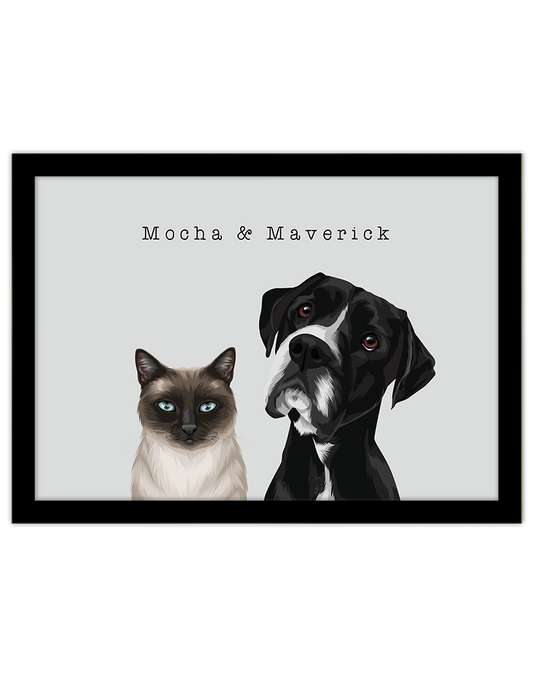

A dog portrait looks like your dog when the artist can clearly see the face, eyes and the features that make that specific dog recognisable: an unusual ear position, a distinctive patch, a particular coat texture. The photo provides the reference; the artist provides the interpretation. A great portrait captures the dog's character, not just their outline.
What "likeness" actually means
A portrait isn't a photograph. It's an interpretation made by hand, based on what the artist can see in the reference image. The goal isn't photorealism. It's recognition. Someone who knows your dog should be able to look at the portrait and immediately know whose dog that is.
That's a different challenge than capturing a technically accurate face. It requires the artist to identify what's distinctive about this particular dog and make sure those things come through in the finished piece.
What the artist uses to create likeness
The eyes. In any portrait, human or animal, the eyes are where character lives. A dog's eyes are also often its most distinctive feature. Getting the eyes right is where likeness lives or dies.
Coat colour and pattern. The specific combination of colours, the way they're distributed, where the boundaries between them fall: this is what makes a border collie look like your border collie rather than any border collie.
Distinctive physical features. The way one ear sits lower than the other. A scar above the eye. A white blaze on the chest that's slightly asymmetric. A docked tail. These details are what make a dog instantly recognisable to anyone who knows them, and an artist who captures them is an artist who's doing their job.
Proportion and breed shape. The silhouette of a greyhound is completely different from a corgi. Getting the body proportions right means the portrait looks like the right kind of dog, as well as the right individual dog.
To commission a portrait created from your dog's photo, the artist works entirely from the image you provide.
What the buyer does that makes this possible
A clear photo. This is the most important thing. The photo guide covers exactly what a portrait-ready image looks like. It's worth reading before you order, not after.
Multiple photos if you have them. The primary photo is the main reference, but a second or third image from a different angle can give the artist reference for features the primary photo doesn't fully capture. If your dog has a distinctive marking that's barely visible in your best photo, a secondary photo showing it clearly is worth sending.
Notes about distinctive features. Small details the artist might not be able to see clearly in the photo: "she has a small scar above her left eye," "his right ear never quite sits straight," "the white on his chest is uneven, more on the left side." The artist can use these to check their work and make sure the right things are coming through.
What can't be fixed
A photo where the face is mostly in shadow or heavily blurred limits what the artist can do. Not because they're not skilled, but because there's no information there to work with. A portrait is based on what's visible. If the eyes are obscured in every photo you have, the portrait's eyes will be a best guess rather than a true representation.
If you're not sure whether your photo gives the artist enough to work with, send it and ask before ordering. It's a straightforward question that saves disappointment later.
Older or blurry photos and likeness
Photos where detail is limited are riskier for likeness. That doesn't mean they won't work, but it does mean the portrait may capture the general impression of your dog rather than their specific details. The guide to using older or blurry photos explains what's workable and what isn't.
What a finished portrait should show
The test is simple: if someone who has never met your dog sees the portrait and then meets your dog for the first time, they should feel like they already know them.
The eyes carry the character. The coat shows the individual. The pose looks natural rather than stiff. Those three things together are what make a dog portrait feel like a portrait of a specific, real dog, not a generic representation.
Create a portrait from your dog's photo at Oh Barney.